Achilles Pain When Running: Why It Hurts and What Actually Helps

Updated: 4 days ago
If the back of your heel feels stiff and sore when you get out of bed, eases off once you get going, then grumbles again after your run, you are not alone. Achilles pain is one of the niggles we see most often in runners across Warwick, Leamington Spa and the surrounding villages, especially when people are building up for a spring marathon or getting back into running after a break.
The good news is that most Achilles pain is very treatable. The bad news is that it rarely goes away on its own if you keep doing exactly what caused it. Here is what is usually going on, what you can do this week, and when to get it looked at.
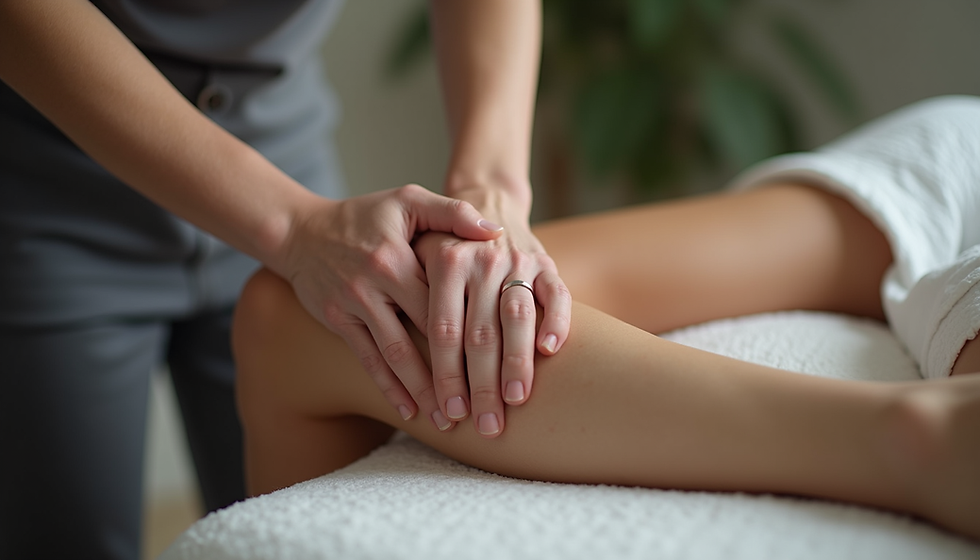
What does Achilles pain actually feel like?
Your Achilles tendon is the thick cord that joins your calf muscles to your heel bone. Every time you push off the ground it takes a lot of load, which is why runners are so prone to irritating it. The classic signs are:
Stiffness and tenderness at the back of the heel, or a little higher up the tendon
Pain that is worst first thing in the morning or when you stand up after sitting for a while
Discomfort at the start of a run that warms up and fades, then comes back afterwards or the next day
Soreness when you press on the tendon or walk up stairs and hills
That warm up pattern is the sneaky bit. Because it feels better once you are moving, it is very tempting to keep running through it.
Why does it happen?
Like most running injuries, Achilles pain is usually a load problem. The tendon has been asked to do more than it is currently ready for. That might be because of:
Adding too much distance too quickly, or a sudden jump in weekly mileage
More hills, speed work or track sessions than your body is used to
A big change in your running style, for example trying to raise your cadence overnight
New shoes, or swapping to a much lower or lighter shoe in one go
Calves that are tired, tight or not strong enough for the work you are asking of them
Not enough recovery between harder sessions, poor sleep or a busy, stressful few weeks
In our guide to running cadence, we explain why changing your step rate too quickly does not prevent injury, it just moves the load somewhere else, very often straight into the calves and Achilles.
What you can do this week
If your Achilles is grumbling but you can walk normally, these steps are a sensible place to start.
Calm it down, do not stop everything. Complete rest rarely fixes a tendon. Tendons like steady, manageable load. Drop the things that make it noticeably worse, such as hills, speed sessions and long runs, and keep easy running or cross training that does not flare it up.
Use the morning as your guide. How your Achilles feels the morning after a run tells you a lot. If it is no worse than usual, that level of activity is probably fine. If it is stiffer and sorer, you did a bit too much, so hold back to your last comfortable level for a few days.
Do not push through sharp pain. Mild stiffness that settles is one thing. Pain that gets worse as you run, makes you change how you run, or is still there the next day is your body asking you to back off.
Be careful with hard stretching and digging into the sore spot. It can feel productive, but aggressively stretching or pressing on an irritated tendon often makes it angrier.
Start rebuilding strength. Tendons get better with the right kind of progressive loading, usually calf strengthening that is built up gradually. The key word is gradually, and the right starting point is different for everyone, which is where an assessment really helps.
For more on whether to rest or keep training, have a read of our physio's guide to recovering from a running injury.
When to get it checked straight away
Please do not wait and see if you notice any of these:
A sudden sharp pain or a feeling of being kicked in the back of the heel, sometimes with a popping or snapping sensation
You cannot push up onto your toes on the affected side
Significant swelling, bruising or a gap you can feel in the tendon
Pain that is getting steadily worse despite cutting back
A sudden injury like this needs to be seen urgently, so contact your GP, NHS 111 or A&E rather than booking a routine appointment.

How we help Achilles pain at TAP
Most physio treats where it hurts, so the pain keeps coming back. We look for why your Achilles is overloaded in the first place, using the same three step approach whether you see us in Warwick or Leamington Spa.
Assess. A proper conversation about your training, your shoes, your week and your goals, plus a full physical assessment of your ankle, calf, foot and the way you move, to find what is driving the problem.
Treat. Hands on treatment from your first session, which may include soft tissue work, mobilisation, dry needling or cupping, always explained before we start.
Rebuild. A clear, staged plan for strength and running, built around your real week, so you know exactly how much to do and how to get back to your normal training without the problem returning. This is the step most quick fixes skip.
You do not need a GP referral, and we offer same week appointments. You can see one of our team for physiotherapy in Warwick at 4 The Holloway in the town centre, or for physiotherapy in Leamington Spa at REGEN Rooms on Augusta Place, a five minute walk from the Parade.
If your calves feel tight and heavy from training but you do not have a specific injury, a sports massage in Warwick can be a great way to support your recovery between sessions. If it is already sore and limiting your running, start with physio so we can find the cause first.
Stopping it coming back
Plenty of runners settle their Achilles, go straight back to their old training and end up back where they started. The long term fix is usually a training plan that builds sensibly and fits around your actual life, with strength work that keeps your calves and tendons ready for what you ask of them.
That is exactly what our online running coaching is built for. Whether you are training for your first 5K or your next marathon, we plan your running around your work, family and schedule and adjust it when life happens, so you get to race day strong rather than injured.
Ready to get back to running?
If your Achilles has been niggling for more than a week or two, or it keeps coming back every time you build your mileage, do not keep guessing. Book your appointment online at our Warwick or Leamington Spa clinic, or call us on 07788 285535, and let's find out what is really going on and get you back running comfortably.


